Bra size calculator: find your bra size in US, UK, EU and AU sizes
Two measurements with a soft tape give your size in every major sizing system. Nothing you type leaves your browser.
More options: leaning and lying bust
For a closer fit, add the bust measured while leaning forward (back flat) and while lying on your back. The calculator averages every bust measurement you give.
Enter your underbust and bust to see your size.
A calculated size is a starting point. Brands cut differently, so check the fit and the brand's own chart. Your measurements stay on this device.
Built by Nitin Raja ·

This bra size calculator works out your band and cup from two tape measurements, the same way professional fitters start: a snug underbust for the band, the bust for the cup. It then converts the result into US, UK, EU, French, Spanish, Belgian and Australian bra sizes, lists your sister sizes and shows where you sit on the bra size chart below. If you add the leaning and lying bust measurements, it averages them for a closer cup. It does not use the old "+4" rule that many store charts still follow, and the page explains why. People also call this a cup size calculator or breast size calculator: the cup letter it gives is not a fixed volume, it is the difference between your bust and band, so a 32D and a 36D hold very different amounts. Everything runs on your device and nothing is stored.
How does the bra size calculator work?
It turns your measurements into inches, because UK and US bra sizes are built on inches. The band is your underbust rounded to the nearest even number. The cup is the difference between your bust and that band, one cup letter per inch: 1 inch is an A, 2 a B, 3 a C, 4 a D, 5 a DD, 6 an E (UK) and so on. The size is then translated into the other systems with the conversion tables brands use.
Worked example. Underbust 76 cm and bust 89 cm. 76 cm is 29.9 inches, which rounds to a 30 band. 89 cm is 35.0 inches. 35.0 minus 30 is a 5 inch difference, and 5 inches is a DD. So the size is a 30DD in the UK, 30DD (E) in the US, 65E in EU sizing, 80E in France, Spain and Belgium and 8DD in Australia. Its sister sizes are 28E, 32D, 34C.
For comparison, the old +4 method would add 4 inches to the band (30 + 4 = 34) and get only a 1 inch difference: a 34A. That is a band two sizes looser and a cup four letters smaller, which is the most common reason a "calculated" bra does not fit.
How to measure your bra size at home: step by step
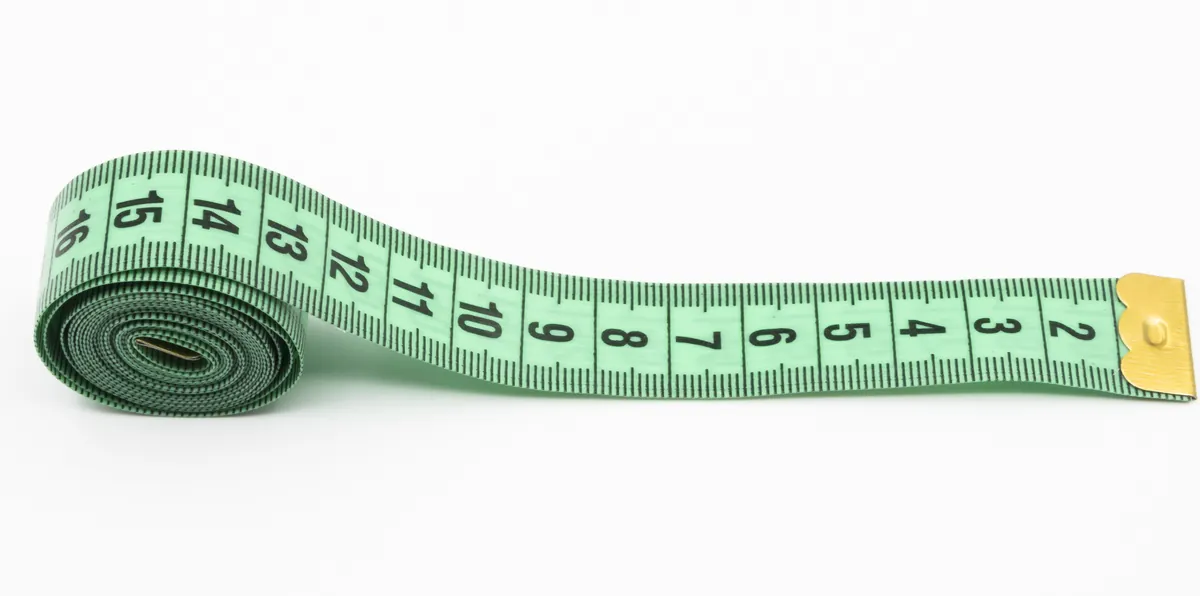
You need a soft tape measure and two minutes. Stand in front of a mirror so you can check that the tape is level at the back.
1. Measure your underbust
Wrap a soft tape measure around your ribcage directly under your breasts, level all the way round and snug: tight enough that it does not slip, but you can still breathe normally. Breathe out and read the number. Type it into Underbust.
2. Measure your standing bust
Stand straight and wrap the tape loosely around the fullest part of your bust, level across your back, without pressing in. Measure over no bra or a thin, non-padded bra. Type it into Bust.
3. Add leaning and lying measurements (optional)
Open More options. Bend forward at the waist so your back is flat and measure the fullest part again, then lie on your back and measure once more. The calculator averages all your bust measurements, which suits tissue that spreads or sits low.
4. Read your size and check the fit
The result gives your size in US, UK, EU, French and Australian sizing, plus sister sizes. Try that size first, then use the fit checklist: band level and firm, no gaps or spilling at the cups, centre front lying flat.
No tape measure? A piece of string or a phone charging cable works: wrap it the same way, mark it, and measure it against a ruler or our actual size online ruler.
Bra size chart
Find your band from your snug underbust, then read across to the bust measurement that matches. Numbers are bust measurements in inches for each UK size (US sizes are the same up to D). For centimetres, multiply by 2.54.
| Band (underbust) | A | B | C | D | DD | E |
|---|---|---|---|---|---|---|
| 28 (69-74 cm) | 29 | 30 | 31 | 32 | 33 | 34 |
| 30 (74-79 cm) | 31 | 32 | 33 | 34 | 35 | 36 |
| 32 (79-84 cm) | 33 | 34 | 35 | 36 | 37 | 38 |
| 34 (84-89 cm) | 35 | 36 | 37 | 38 | 39 | 40 |
| 36 (89-94 cm) | 37 | 38 | 39 | 40 | 41 | 42 |
| 38 (94-99 cm) | 39 | 40 | 41 | 42 | 43 | 44 |
| 40 (99-104 cm) | 41 | 42 | 43 | 44 | 45 | 46 |
| 42 (104-109 cm) | 43 | 44 | 45 | 46 | 47 | 48 |
| 44 (109-114 cm) | 45 | 46 | 47 | 48 | 49 | 50 |
| 46 (114-119 cm) | 47 | 48 | 49 | 50 | 51 | 52 |
Read: a 32 band with a 36 inch bust is a 32D. Bust measurements between two columns round to the nearest inch. On phones the F and FF columns are hidden: add one inch per cup.
Bra size conversion chart: US, UK, EU, French and Australian bands
The band number changes from country to country, but the underlying size is the same. This is the conversion table brands print on their size guides:
| US / UK | EU | France, Spain, Belgium | Australia, NZ |
|---|---|---|---|
| 28 | 60 | 75 | 6 |
| 30 | 65 | 80 | 8 |
| 32 | 70 | 85 | 10 |
| 34 | 75 | 90 | 12 |
| 36 | 80 | 95 | 14 |
| 38 | 85 | 100 | 16 |
| 40 | 90 | 105 | 18 |
| 42 | 95 | 110 | 20 |
| 44 | 100 | 115 | 22 |
| 46 | 105 | 120 | 24 |
Bra cup size chart: what the cup letters mean
The cup letter only means something together with the band: it is the difference between bust and band. UK sizes add double letters (DD, FF, GG), US brands usually use DD, DDD and then G, and EU sizes use single letters, so the same cup can carry three different letters:
| Bust minus band | UK, AU | US | EU, FR |
|---|---|---|---|
| under 1 in (0.0 cm) | AA | AA | AA |
| 1 in (2.5 cm) | A | A | A |
| 2 in (5.1 cm) | B | B | B |
| 3 in (7.6 cm) | C | C | C |
| 4 in (10.2 cm) | D | D | D |
| 5 in (12.7 cm) | DD | DD (E) | E |
| 6 in (15.2 cm) | E | DDD (F) | F |
| 7 in (17.8 cm) | F | G | G |
| 8 in (20.3 cm) | FF | H | H |
| 9 in (22.9 cm) | G | I | I |
| 10 in (25.4 cm) | GG | J | J |
| 11 in (27.9 cm) | H | K | K |
| 12 in (30.5 cm) | HH | L | L |
| 13 in (33.0 cm) | J | M | M |
US letters after DD are the least consistent: some brands call the 6 inch cup DDD, some F. When in doubt, compare against the UK letter, which most specialist brands print as well.
Why the +4 method gives the wrong bra size
Many store charts and older calculators add 4 inches to an even underbust measurement (5 to an odd one) to get the band. It is often explained as a leftover from bands that barely stretched. Whatever its origin, modern bands are elastic, so a band 4 inches bigger than your ribcage ends up loose: it rides up at the back and the straps end up doing the supporting.
Because the cup is calculated from the band, the extra 4 inches also shrinks the cup by four letters. People sized this way often see cups that look too small on a band that is too big, and then try a bigger band, which makes it worse. A University of Portsmouth study of 45 women (White and Scurr, Ergonomics, 2012) found that the traditional method overestimated band size and underestimated cup size compared with professional bra fitting criteria. The measured band used here avoids that.
A measured band is not always the final answer: some people with a very soft underbust, or who prefer a looser feel, end up one band size up. That is what sister sizes are for.
What are sister sizes?
Sister sizes hold about the same cup volume on a different band. Go down one band size and up one cup letter, or up one band and down one cup: 30DD, 32D and 34C are sister sizes, and so are 28E and 30DD. Use them when the cups fit but the band is too loose (go down a band, up a cup) or too tight (go up a band, down a cup). The calculator lists the nearest sister sizes under your result.
How should a bra fit? A quick fit check
- Band: level all the way round, firm on the loosest hook when new (so you can tighten it as it stretches). You should fit about two fingers under it, no more.
- Cups: no gap at the top or sides, and no spilling over the top or under the arms. The wire should sit on your ribcage behind the breast tissue, not on it.
- Centre front: the middle part between the cups lies flat against your sternum. If it lifts away, the cups are usually too small.
- Straps: do not dig in and do not slip. If they carry most of the weight, the band is probably too loose.
- Movement: lift your arms and lean forward. The band should stay put and nothing should slip out.
If the band rides up, try a smaller band (and a bigger cup to keep the volume). If the cups gap, try a smaller cup or a different cup shape before changing the band.
US vs UK bra sizes: what is the difference?
Bands are the same number in the US and the UK: a 34 is a 34. Cups match up to D. After that the UK goes DD, E, F, FF, G, GG, H, while many US brands go DD, DDD (or F), G, H, I. So a UK 34E is usually a US 34DDD, and a UK 34F is a US 34G. Some American brands use UK-style letters, so check which system the size guide uses.
European, French and Australian bra sizes
EU sizes give the band in centimetres in steps of 5: 65, 70, 75, and a UK 30 is sold as an EU 65. France, Spain and Belgium add 15 to the EU number, so EU 65 is an 80 in France. Australia and New Zealand use dress-size style numbers: 8, 10, 12, with UK-style cups. The European standard EN 13402-3 also defines sizes directly from body measurements: band = underbust rounded to 5 cm, and a cup letter for every 2 cm of bust minus underbust, with A starting at 12 cm. For the 76 cm / 89 cm example that rule gives an EU 75A, close to the +4 result, while the conversion tables give 65E. Both are printed in Europe; the calculator shows the conversion-table size first because that is what most brands' size guides use, and lists the body-measurement size underneath your result.
Do bra sizes vary between brands?
Yes, often by a band or a cup. Bands differ in stretch, cups differ in depth and shape, and wires differ in width. Many people wear one size in one brand and a sister size in another. A practical approach: start with the calculated size, read the brand's size guide, and keep a note of what fits in each brand you like. Plunge and balconette styles often feel smaller than full-cup styles in the same size.
How often should you measure your bra size?
Measure again whenever your bras stop fitting, after a change in weight, during and after pregnancy or breastfeeding, and when changing to a new brand. Many people measure once a year. Measure at the same time of day and in the same way, because breathing, posture and the time of month all move the numbers a little.
Why we built this bra size calculator
Before building CheckMyHeight, I tested a lot of sizing websites to see what people actually need from them and what just gets in the way. Bra sizing shows why that matters: a calculator can give a wrong size with total confidence.
The problem is well documented. Many store charts and older calculators still add 4 or 5 inches to the underbust to find the band. A University of Portsmouth study (White and Scurr, 2012) found that this traditional method overestimated band size and underestimated cup size compared with professional fitting criteria, which matches the usual complaint: a band that rides up and cups that look too small. Chart-only sizing has a second problem. Cup letters are not the same in every country (a UK E is a US DDD and an EU F), so a chart made for one market sends people in another to the wrong letter. And a store's own calculator usually answers only in that store's sizes, sometimes after asking for an email address.
So we wanted one page that measures the band the way fitters do, shows every major sizing system side by side, shows the +4 and EN 13402 answers next to ours so you can see why they differ, and asks for nothing except two numbers.
What this bra size calculator measures
It takes your underbust and your standing bust, in centimetres or inches, plus two optional extra bust measurements: leaning forward and lying down. You do the measuring with a soft tape; the calculator does the arithmetic. Here is exactly what the code does:
- Units: everything is converted to inches (1 in = 2.54 cm), because UK and US bra sizes are built on inches.
- Band: the snug underbust rounded to the nearest even number, from 26 to 56. No inches are added.
- Bust: the average of every bust measurement you give (one, two or three).
- Cup: bust minus band, rounded to the nearest inch, one cup letter per inch, from AA up to a UK L.
- Labels: the same size written in US, UK, EU, French/Spanish/Belgian and Australian sizing with the conversion tables brands print (UK 30 = EU 65 = FR 80 = AU 8).
- Sister sizes: one band down and one cup up, and one or two bands up with the cup going down.
- Checks: the EN 13402-3 body-measurement size and the old +4 size for comparison, a note when your underbust falls right between two bands, and a note when your standing, leaning and lying numbers differ by 2 inches or more.
The conversions were last checked on 24 October 2026, and the worked example on this page (76 cm and 89 cm, a UK 30DD) is one of the automated tests the maths must pass before the site is published. What it does not measure: breast shape, root width, projection or how soft the tissue is, all of which decide which style fits; how a particular brand's band stretches; or anything medical. It never sees you, has no camera step, and keeps nothing after you close the page.
Why this bra size calculator is different
Every point below can be checked on this page:
- It starts empty. No sample size is filled in and no result appears until you type your own numbers.
- The method is shown, not hidden. The formula, a worked example and the reasons it disagrees with +4 are all written out above.
- Five sizing systems at once, so you can shop in a UK, US or European store with the same result.
- No account, no email. The calculation runs in your browser and nothing you type is sent anywhere.
- A share link restores your measurements, so you can come back to them or send them to someone helping you shop.
- Sources are cited at the end of the page, including the study and the European standard.
| Feature | This calculator | Typical store calculator |
|---|---|---|
| Band method | Measured band (no +4) | Often +4 or +5 |
| Leaning and lying bust | Optional, averaged | Usually standing only |
| Sizing systems | US, UK, EU, FR/ES/BE, AU/NZ | Usually the store's own |
| Other methods shown | +4 and EN 13402 sizes next to yours | One answer, method not shown |
| Sister sizes | Listed with the result | Sometimes |
| Privacy | Runs in your browser, nothing sent | Varies |
| Sign-up or email | No | Sometimes asked |
How accurate is this bra size calculator?
The arithmetic is exact; the measuring is where differences come from. A tape pulled 1 cm tighter or looser, or held at a slant, can move the result by one band or one cup. Measure two or three times and use the most consistent numbers. The calculator also flags two common cases: an underbust right between two band sizes (both are worth trying), and a big difference between your standing, leaning and lying measurements (the averaged cup may need a different shape rather than a different size). No calculator replaces trying a bra on, and this one is not a medical or health tool.
Sources
- White J, Scurr J. Evaluation of professional bra fitting criteria for bra selection and fitting in the UK. Ergonomics 2012; 55(6): 704-711.
- CEN, EN 13402-3, size designation of clothes: body measurements and intervals (bra band and cup rule).
- Brassiere measurement (Wikipedia): band conversions between countries and the history of the +4 method.
- Band and cup conversions: the size tables published by bra makers (UK 30 = EU 65 = FR 80 = AU 8; UK DD = EU E).
Bra size FAQ
How do I calculate my bra size?
Measure your underbust snugly in inches and round to the nearest even number: that is your band. Measure the fullest part of your bust loosely and subtract the band: each inch of difference is one cup size (1 inch A, 2 inches B, 3 inches C, 4 inches D, 5 inches DD). The calculator above does this in centimetres or inches and converts the result to every sizing system.
What is my bra size if my underbust is 32 and my bust is 36 inches?
32D in UK and US sizing: the band is 32 and the 4 inch difference is a D cup. In EU sizing that is 70D, in French sizing 85D and in Australia 10D.
Is a 34C the same as a 32D?
They are sister sizes: the cups hold about the same volume, but the 32D has a tighter band. Going down a band size and up a cup size (34C to 32D), or up a band and down a cup (34C to 36B), keeps the cup volume roughly the same.
What is a 30DD in EU sizes?
A UK or US 30DD is an EU 65E, a French 80E and an Australian 8DD. The band number changes between systems and so do the cup letters: after D, the UK uses DD, E, F, FF while EU sizes go E, F, G, H.
Should I measure my bra size with a bra on?
Measure your underbust over bare skin or a thin bra, and your bust over no bra or a thin, non-padded one. Padding or a push-up adds centimetres to the bust measurement and gives you a cup size that is too big.
Why do the old +4 calculators give me a different size?
The traditional method adds 4 or 5 inches to the underbust to find the band. That gives a bigger band and, because the cup is the bust minus the band, a smaller cup. With an underbust of 76 cm and a bust of 89 cm, the +4 method gives 34A, while the measured band gives 30DD. A study at the University of Portsmouth found the traditional method overestimated band size and underestimated cup size compared with professional fitting criteria.
Why is my size different in every brand?
Bra sizes are not made to one shared pattern. Band stretch, cup shape, wire width and the fabric all change how a size fits, so many people wear one size in one brand and a sister size in another. Use the calculated size as the starting point and check the brand's own size chart.
Is anything I type saved or sent anywhere?
No. The calculator runs entirely in your browser and nothing you type is uploaded or stored. If you copy the share link, your measurements are in that link, so only share it with people you choose.