Ski size calculator: ski length for your height, plus a DIN setting estimate
Height, weight and ability give your ski length range. Add your age and boot sole length to see what the DIN chart says.
More options: ski type and DIN setting
Not chosen: beginner counts as type I, intermediate as II, advanced and expert as III.
Enter your height and weight and pick your ability to see your ski length.
Indicative only. Ski bindings must be set and checked by a certified ski technician with a calibrated tester. Never set your own bindings from a calculator.
Ski lengths vary by model; check the brand's size chart. DIN values here are for understanding only, never for adjusting bindings yourself.
Built by Nitin Raja ·
This ski size calculator gives the ski length that suits your height, weight and ability, for carving, all-mountain, powder or park skis, and shows an indicative DIN setting from the ISO 11088 chart that ski shops use. Ski length for height is the starting point most guides use: between your chin and the top of your head, shorter while you learn and longer as you ski faster. The calculator turns that into a 6 cm range for you, shows it to scale next to your height, and adjusts for weight when you are heavy or light for your height. The ski size chart and the DIN chart below show the full tables. One rule never changes: release settings are set and tested by a certified technician, and the DIN estimate here is only so you understand the number.
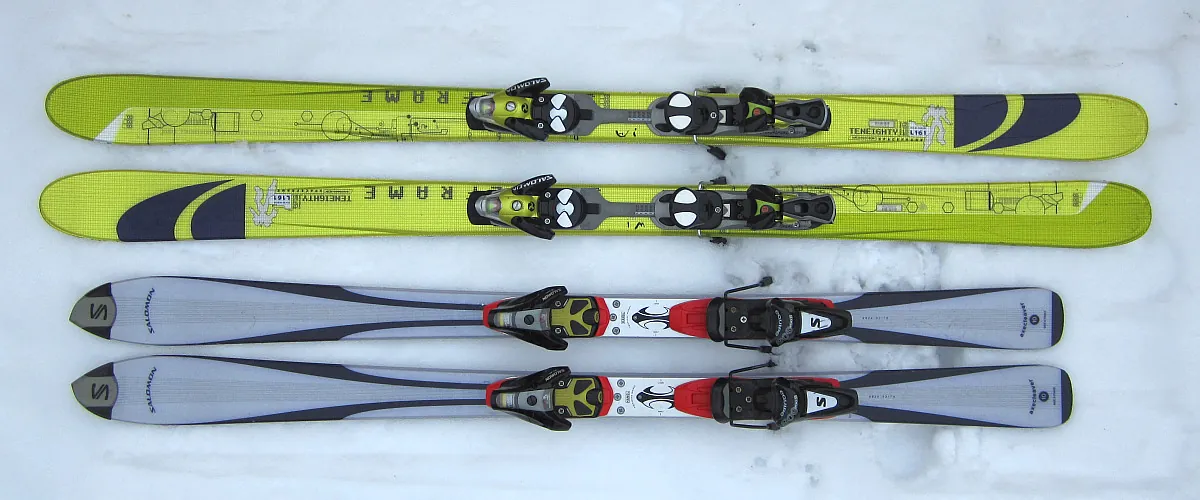
How does the ski size calculator work?
The length comes from evo's ski size chart, which gives one length per height for beginners, intermediates and experts. Across that chart, beginner skis are about 12-13 cm shorter than the skier, intermediate skis about 3 cm shorter and expert skis about 5-6 cm longer. The calculator uses those offsets (advanced sits between intermediate and expert), takes 4 cm off for carving skis and adds 5 cm for powder skis, adds 3-5 cm if your weight is high for your height (a body mass index of 27 or more) and takes 3 cm off if it is low (under 18.5). The result is a range 3 cm either side.
Worked example. A 170 cm (5′ 7″), 65 kg (143 lb) intermediate skier on all-mountain skis: 170 - 3 = 167 cm, and a BMI of 22.5 needs no weight change. The range is 164-170 cm, matching evo's 165 cm at 168 cm tall and 170 cm at 173 cm. With a 305 mm boot sole, age 35 and skier type II, the DIN chart reads 5.5 (code K), as explained below.
How to choose your ski length: step by step
1. Enter your height and weight
Type your height in centimetres or feet and inches and your weight in kilograms or pounds. Height sets the starting length; weight well above or below average for your height moves it.
2. Choose your ability
Pick beginner, intermediate, advanced or expert. Beginners ski best on skis around chin height; experts on skis around or above head height.
3. Choose the ski type (optional)
Open More options and pick carving, all-mountain, powder or park. Carving skis are skied shorter and powder skis longer.
4. Add age and boot sole length for a DIN estimate (optional)
Enter your age and the boot sole length in millimetres, printed on the heel or side of your ski boot. The calculator shows the DIN setting the ISO 11088 chart gives, for reference only: a certified technician must set and test your bindings.
Ski size chart
Ski lengths in centimetres for all-mountain skis at an average weight for each height. Carving skis about 4 cm shorter, powder skis about 5 cm longer. On phones the advanced column is hidden: it sits about 4 cm above intermediate.
| Height | Beginner | Intermediate | Expert |
|---|---|---|---|
| 150 cm (4′ 11″) | 135-141 | 144-150 | 153-159 |
| 155 cm (5′ 1″) | 140-146 | 149-155 | 158-164 |
| 160 cm (5′ 3″) | 145-151 | 154-160 | 163-169 |
| 165 cm (5′ 5″) | 150-156 | 159-165 | 168-174 |
| 170 cm (5′ 7″) | 155-161 | 164-170 | 173-179 |
| 175 cm (5′ 9″) | 160-166 | 169-175 | 178-184 |
| 180 cm (5′ 11″) | 165-171 | 174-180 | 183-189 |
| 185 cm (6′ 1″) | 170-176 | 179-185 | 188-194 |
| 190 cm (6′ 3″) | 175-181 | 184-190 | 193-199 |
| 195 cm (6′ 5″) | 180-186 | 189-195 | 198-204 |
Ski length for your height
Stand a ski on its tail next to you. A ski that reaches your chin turns easily and is forgiving; one that reaches your nose or eyes is the all-round choice for an intermediate; one at or above the top of your head is stable at speed and floats in powder. That chin-to-head span is roughly 20 cm for most adults, which is why every chart gives a range, not one number.
Ski size by ability: beginner, intermediate, advanced and expert
Beginners learn faster on shorter skis because they pivot easily at low speed. Intermediates who ski parallel turns on groomed runs suit skis around nose height. Advanced and expert skiers who ski fast, carve long turns or ski off-piste want the stability of a longer ski. If you are between two levels, choose by the terrain you actually ski most.
Ski length by ski type: carving, all-mountain, powder and park
- Carving (frontside) skis are narrower with a tight turning radius; they are skied a few centimetres shorter for quick, short turns on groomed snow.
- All-mountain skis are the middle of the chart, with a medium width underfoot (evo calls about 100 mm a versatile all-mountain width).
- Powder and freeride skis are wider with rocker in the tip; they are skied longer for float and stability in deep snow.
- Park skis are twin tips with an upturned tail, so less of the ski touches the snow; many park skiers keep their all-mountain length, others go shorter for spins.
Rocker (an early-rising tip or tail) makes a ski feel shorter than its length on firm snow, so a heavily rockered ski is often chosen a few centimetres longer.
Does weight change ski length?
Yes, a little. A heavier skier bends a ski more, so a longer or stiffer ski feels right; a lighter skier controls a shorter ski better. evo's guide lists weight as a factor alongside height. The calculator adds 3 cm for a body mass index of 27 or more, 5 cm for 30 or more, and takes 3 cm off under 18.5.
What is a ski DIN setting?
DIN is the release setting on a ski binding: the force at which the binding lets your boot go in a fall. The name comes from the German standards body that first defined the scale; today the method that shops use is ISO 11088. Too low and the ski can come off while you are skiing; too high and it may not release when it should. The value depends on your weight, height, age, how you ski (skier type) and the length of your boot sole, because a longer sole gives more leverage on the binding.
How the DIN chart works (ISO 11088)
- Skier code from weight and height. Find the code letter for your weight and the one for your height in the chart below. Use the one nearer the top (nearer A).
- Skier type. Type I: no change. Type II: one row down. Type III: two rows down.
- Age. Aged 50 or over, or 9 or under: one row up.
- Boot sole length. Read across the final row to the column for your boot sole length in millimetres. That number is the indicative setting for toe and heel.
Worked DIN example. 65 kg is code J; 170 cm is code K. J is nearer the top, so the code is J. Skier type II moves it one row down to K. Age 35 changes nothing. A 305 mm boot sole is in the 291-310 column, where row K reads 5.5. As type I it would be 4.5, as type III 6.5.
Ski DIN chart
Adult part of the chart (codes G to O, boot soles from 251 mm). Codes N and O are only reached by moving down for skier type. Children's rows A to F and short boot soles are in the calculator.
| Code | 251- | 271- | 291- | 311- | 331- | 351+ |
|---|---|---|---|---|---|---|
| G | 3 | 2.75 | 2.5 | 2.25 | 2 | - |
| H | 3.5 | 3 | 3 | 2.75 | 2.5 | - |
| I | 4.5 | 4 | 3.5 | 3.5 | 3 | - |
| J | 5.5 | 5 | 4.5 | 4 | 3.5 | 3 |
| K | 6.5 | 6 | 5.5 | 5 | 4.5 | 4 |
| L | 7.5 | 7 | 6.5 | 6 | 5.5 | 5 |
| M | - | 8.5 | 8 | 7 | 6.5 | 6 |
| N | - | 10 | 9.5 | 8.5 | 8 | 7.5 |
| O | - | 11.5 | 11 | 10 | 9.5 | 9 |
Values from the ISO 11088 chart as printed in ski binding makers' shop charts and DIN reference sites; published versions differ slightly in column edges. A dash means no value for that combination. For reference only: settings are made by a certified technician.
Boot sole length: where to find it
Your boot sole length (BSL) is printed or moulded on the side or heel of the boot shell, as a three-digit number in millimetres, for example 305 mm. It is not your shoe size and not the mondopoint size (such as 26.5) on the boot's label. The same foot size can have different sole lengths in different boot models, which is why the binding has to be adjusted to each boot.
Why a certified technician must set your bindings
The chart only gives the starting value. A shop technician sets the binding to your boot, checks forward pressure and toe height, and tests the release with a calibrated device to make sure the binding actually releases at the indicated value. Old or worn bindings may not, and some bindings are no longer certified (indemnified) for service. Ask the shop for the setting and keep the ticket. Never adjust release values yourself based on any calculator or chart.
Why we built this ski size calculator
Before building CheckMyHeight, I tested a lot of height and sizing websites to see what people actually need from them and what just gets in the way. Ski sizing splits into two questions that are usually answered in two different places. Length is the easy one: shops and online charts both start from your height and your ability, though most charts give a single height column and leave weight and ski type as general advice. Bindings are where people get confused. The DIN number is not a size you pick: it comes from a table in ISO 11088 that combines your weight, height, skier type, age and the sole length printed on your boot, and many people only meet it as a number a shop writes on a ticket.
We wanted one page that gives a length range from the same factors a good shop asks about, and that walks through the DIN chart step by step so the number makes sense, while saying plainly that it is an estimate and a certified technician must set the bindings.
What this ski size calculator measures
You enter your height, weight and ability; ski type, age, boot sole length and skier type are optional. The code does this:
- Length: your height plus an ability offset taken from evo's ski size chart: beginner 12.5 cm shorter, intermediate 3 cm shorter, advanced 1 cm longer, expert 5.5 cm longer.
- Ski type: carving 4 cm shorter, powder 5 cm longer; all-mountain and park unchanged.
- Weight: a BMI of 27 or more adds 3 cm, 30 or more adds 5 cm, under 18.5 takes 3 cm off. The range is the result plus and minus 3 cm.
- Indicative DIN (ISO 11088 method): a skier code from your weight and one from your height, taking the one nearer the top of the table; one row down for skier type II, two for type III; one row up for age 50 and over or 9 and under; then the value in your boot sole length column.
Chart values last checked on 24 October 2026, and the worked examples on this page are automated tests the maths must pass before the site is published. What it does not measure: your boots' fit, the ski model's rocker and sidecut, the binding's condition, or whether a binding actually releases at a value. Only a shop with a calibrated tester can check that.
Why this ski size calculator is different
- It starts empty. Nothing is filled in and no length appears until you enter your height, weight and ability.
- Length and DIN on one page, with every step of the DIN chart shown rather than a bare number.
- Honest about DIN: the value is labelled indicative, and the page explains why a technician must set it.
- Weight and ski type count, not height alone.
- A to-scale picture of you next to the ski range, a share link that restores your inputs, and no account: it all runs in your browser.
| Feature | This calculator | Typical ski size chart |
|---|---|---|
| Height and ability | Yes, four levels | Yes |
| Weight | Adjusts when high or low for your height | Usually advice only |
| Ski type | Carving, all-mountain, powder, park | Sometimes |
| DIN estimate | Full ISO 11088 steps, shown with its working | Separate DIN tools |
| To-scale picture | You next to the ski range | No |
| Share link | Restores your inputs | No |
How accurate is this ski size calculator?
The length formula reproduces evo's chart within a centimetre or two for average builds, and the range covers the usual chin-to-head span. Your choice within the range depends on the ski model, its rocker and your terrain. The DIN number follows the published chart, but different printings of the chart draw the boot sole column edges a little differently, so the value can sit a quarter or half a step away from what a shop sets, and shops may adjust for skiers who request it. That is exactly why it is labelled indicative.
Sources
- evo, How to Choose Skis and Ski Size Chart: ski length by height and ability, and the factors that move it.
- ISO 11088, Assembly, adjustment and inspection of an alpine ski/binding/boot (S-B-B) system (2018 edition, revised as ISO 11088:2023). Chart values as printed in binding makers' shop charts.
- Ski binding (Wikipedia): how release bindings work.
Ski size and DIN FAQ
What size skis do I need for my height?
Most adults ski on skis between chin height and the top of the head. Beginners stay near the chin, experts near or above the head. A 170 cm (5 ft 7 in), 65 kg intermediate skier fits about 164-170 cm on an all-mountain ski. Enter your own height, weight and ability above for your range.
What length skis for a 6 ft man?
For a 6 ft (183 cm), 80 kg (176 lb) intermediate skier, about 177-183 cm on an all-mountain ski. Shorter for carving skis or if you are still learning, longer for powder skis or if you ski fast.
Should beginners use shorter skis?
Yes. Shorter skis turn more easily at low speed, which makes learning faster. A 165 cm, 60 kg beginner fits about 150-156 cm, roughly chin height. Once you ski parallel turns on blue runs, go up a few centimetres.
What DIN setting should I use?
Your DIN setting depends on your weight, height, age, skier type and boot sole length, read from the ISO 11088 chart. For example, a 65 kg, 170 cm skier aged 35, skier type II, with a 305 mm boot sole is at code K, which reads 5.5 in the chart. The setting must be made and tested by a certified ski technician: this page is for understanding the number, not for setting bindings yourself.
What is skier type I, II and III?
Skier type describes how you want your bindings to release. Type I skiers ski cautiously at slow to moderate speeds and prefer easier release. Type II is the average skier at varied speeds on varied terrain. Type III skiers ski fast and aggressively on steep terrain and accept a higher release setting. Each type moves one row down the chart.
Where do I find my boot sole length?
It is moulded or printed on the side or the heel of the ski boot shell, a three-digit number in millimetres such as 305 mm. Do not confuse it with the mondopoint size (such as 26.5), which is your foot length in centimetres.
Can I adjust my own ski bindings?
You should not. Release settings protect your knees and legs, and a shop technician sets them with a calibrated tester and checks that the binding actually releases at the right force. Use the DIN number from any calculator, this one included, only to understand what the shop sets.
Is my data saved?
No. The calculator runs in your browser and nothing is stored or uploaded. The share link puts your inputs in the address, so only send it to people you choose.